1
Chẩn đoán
Đánh giá mức sẵn sàng làm Business Analyst
Chấm từng chiều kỹ năng và cho ra hồ sơ — biết mình đứng ở đâu trước.
Làm bài nàyProduct discovery theo 4 risks: value, usability, feasibility, viability; opportunity assessment, experiments, case studies và decision rules.
Đăng nhập để đánh dấu kỹ năng và theo dõi tiến độ.
Product discovery là quá trình giảm rủi ro trước khi build. Team không chỉ hỏi “build cái gì?” mà hỏi “problem nào đáng solve, cho ai, vì sao bây giờ, và evidence nào đủ mạnh để quyết định?”.
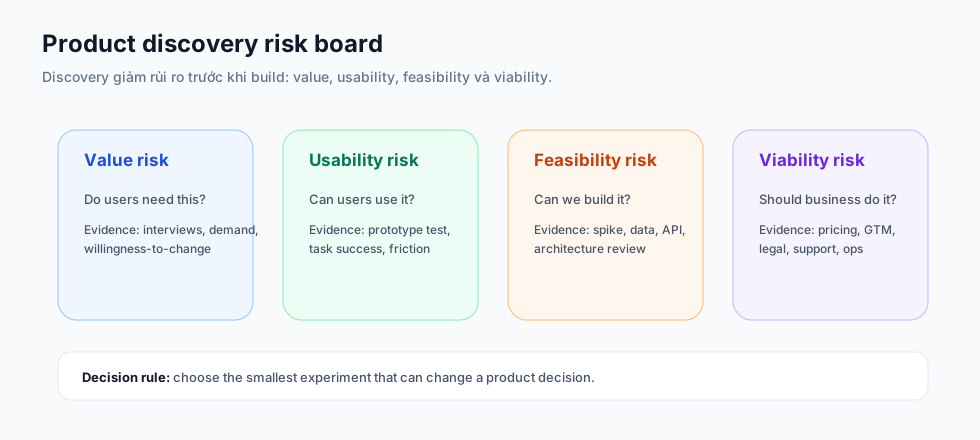
| Risk | Question | Best evidence | Technique |
|---|---|---|---|
| Value | Do users need this? | Past behavior, workaround, paid demand. | Interview, concierge, fake door. |
| Usability | Can they use it? | Task success, confusion, time-on-task. | Prototype test. |
| Feasibility | Can we build it? | Spike, data/API proof. | Technical spike. |
| Viability | Should business do it? | Pricing, support, legal, GTM fit. | Business review, pilot. |
| Customer/segment | Who has the strongest pain? |
| Problem | What happens, when, and why it matters? |
| Evidence | Quotes, behavior, data, tickets, revenue risk. |
| Current workaround | What they do today and what it costs. |
| Risks | Value/usability/feasibility/viability unknowns. |
| Experiment | Smallest test that changes decision. |
| Success metric | What evidence means continue or stop. |
Company wants to build a full onboarding wizard. Discovery shows the highest-risk assumption is not usability; it is whether admins know invite failures happen. Team runs fake-door “invite health report” and interviews admins who clicked. Result: build lightweight invite status dashboard, not full wizard.
Chấm từng chiều kỹ năng và cho ra hồ sơ — biết mình đứng ở đâu trước.
Làm bài này
Thảo luận & tài liệu thêm 0
Chia sẻ kinh nghiệm, đặt câu hỏi, hoặc đính kèm tài liệu/YouTube giúp người khác học kỹ năng này.